Scallop Fever

It’s been about four decades since scallop fever hit our bay shores. Back then, the buzz started shortly after Labor Day. Men sitting at the counters of local coffee shops in the early morning or at the bars later in the day whispered conspiratorially to one another.
“I threw a drag over today.”
“Oh yeah?”
“There’s a few out there. Keep it to yourself.”
“ ‘Bout time. We haven’t had a good season in ages.”
Scallop season was fast approaching. Every year, soon after most of the summer tourists had left Cape Cod, fishermen began thinking about scallops. Illegal to harvest until later in the fall, fishermen nonetheless took a chance during early mornings or on foggy days, when shellfish constables were unlikely to see them, to do a “test drag,” looking for the succulent bivalves. If they found some legal scallops, they tried to keep it to themselves. But word eventually got out, and before long, “scallop fever” – the anticipation for a good scallop season – gripped the community.
Fishermen checked their gear, made repairs, and got ready. Then, on October 1 for Cape Cod Bay, Columbus Day for Nauset or November 1 for Pleasant Bay, whichever body of water had the scallops that year, they thronged to every landing and headed out at dawn as if someone had fired a gun to start the race.
There is nothing quite like opening day of scallop season when scallops are abundant. The scallops seem to cause an irrational emotional reaction in people. They get all worked up almost to a frenzy anticipating the scallop season, especially if there is a hint that there may be a good year ahead. So, if the rumors proved true, it was cause for excitement all over town.
Bay scallops (Argopecten irradians irradians) are quirky in abundance – good one year and very poor for the next several years, and then an inexplicable peak in numbers. A good scallop year gives an economic jolt to the fishing community that allows it to stay afloat during winter when money is usually scarce. Everyone in town benefits from a good scallop year because of the ripple effect from the fishermen they hire to open (shuck) the scallops, the markets and restaurants that sell them, the businesses that supply the gear, and all the way to the people they pay for past bills.
One year, scallops were located in a relatively small area of Cape Cod Bay, within a mile from shore, but straddling town boundaries of Orleans and Brewster. The only landing place was Rock Harbor in Orleans. Orleans and Eastham had a joint fishery, created when Orleans split off from Eastham as a separate town. Brewster had no harbor. So, fishermen from three towns were all able to harvest the scallops. It was a once-in-a-generation occurrence and while the scallops were small, they were plentiful and everyone did well. However, Cape Cod Bay was notorious for having swift changes in weather conditions and there were small boats out there that tempted fate. They courted disaster but luckily for the few weeks that weather allowed harvest, no major mishaps took place.
In Pleasant Bay, the best year was in the early 80s. Three years saw abundant harvests of 4,000 bushels worth nearly $200,000. But in 1983, there was a virtual bonanza. No one had seen anything like it. When the season ended, 37,500 bushels were harvested at a value of $1,550,000. There were a lot of new trucks driving through town. It never happened again.
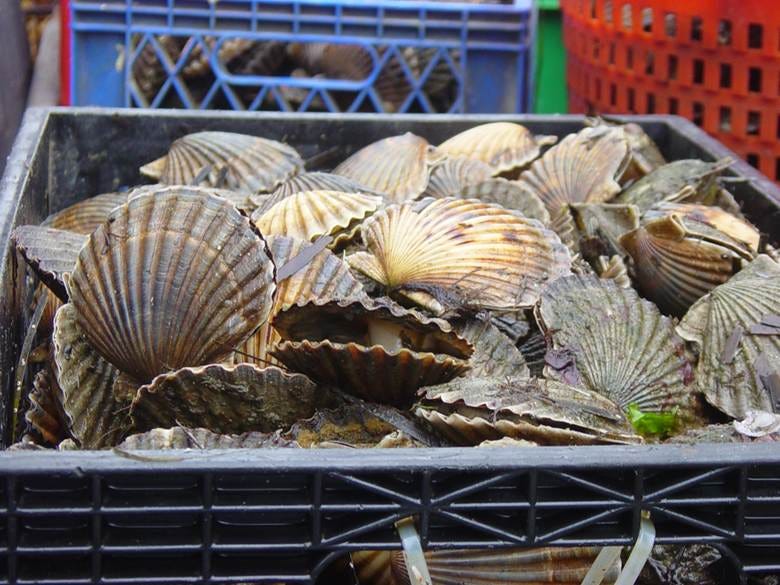
Bushel totes of scallops
Twenty-five years later, the memory was still strong of that past year. November 1 was a beautiful fall day. Low tide was early in the morning and by 8 AM, the landing at Portanimicut was full – cars and trucks with trailers lining the right side of the road. Just offshore, the sight was one unfamiliar to anyone moving to town after 1983. A dozen or more 14-25 ft. boats of all descriptions, pulling drags, motored slowly among the few remaining moored recreational boats. Family permit holders, allowed one bushel a week, walked along the shore, each one tethered to a bushel wire basket floating inside an inner tube. A man with a kayak approached the landing with his catch while another man in a dinghy, leaned over the side of his tiny craft, quahaug scratcher in hand, tempting fate with only a couple of inches of freeboard.
Twenty-five years earlier, a man watching the activity at the landing would have been one of the first men out on the water, but this day he was ashore. When asked why, he said simply, “I don’t have a boat.”
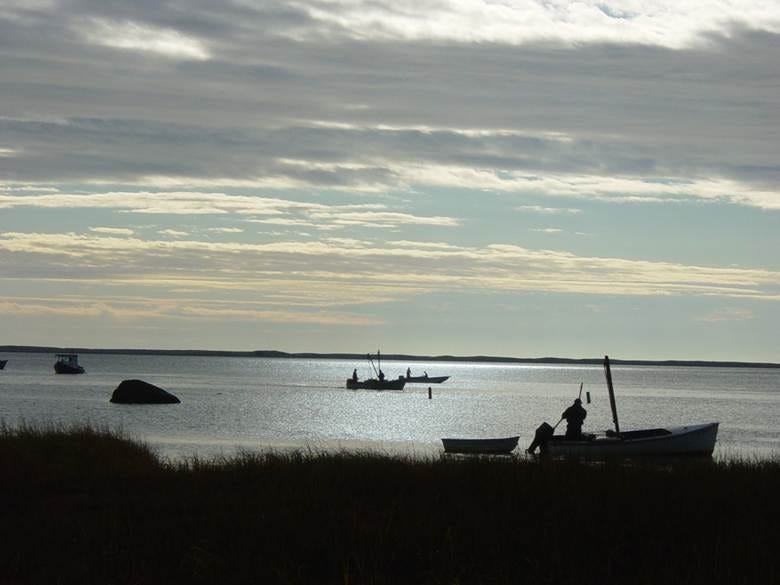
But it would take more than a boat to get a commercial limit of scallops – it would take a license. Obtaining a commercial license just to get scallops would take an act of faith because commercial licenses were only available from January 1 until April 30 of each year. Since scallops had been nearly non-existent for the intervening years, few had faith in their return. But for those who bought a $100 license that year, they were rewarded. How long the scallops would last and where they would be found was anyone’s guess .
The bigger question was why that year? For Pleasant Bay, the answer may have resided in dramatic changes in the bay over the previous two years.
In April 2007, a storm punched a hole in the Nauset barrier beach about a mile north of an historic 1987 breach. The new cut caused the loss of beach camps, but water quality improvements shared the press coverage. Stronger currents, clearer water, and greater abundance of eelgrass, were some obvious changes but the change in eelgrass meadows may relate to the appearance of scallops.
Scallops prefer to attach to eelgrass when they are tiny – barely visible to the naked eye. They attach to the blades of grass by use of a strong byssal thread, similar to the way mussels attach to rocks, sand or each other. By attaching to the eelgrass, the baby scallop keeps out of harm’s way of crawling crabs.
Both eelgrass and scallops require high water quality to survive and thrive and are extremely sensitive to environmental changes, especially those caused by humans. They are key species for estuarine health and scallops remain an icon of the shellfish industry. Environmental/biological responses to physical changes often take several years.
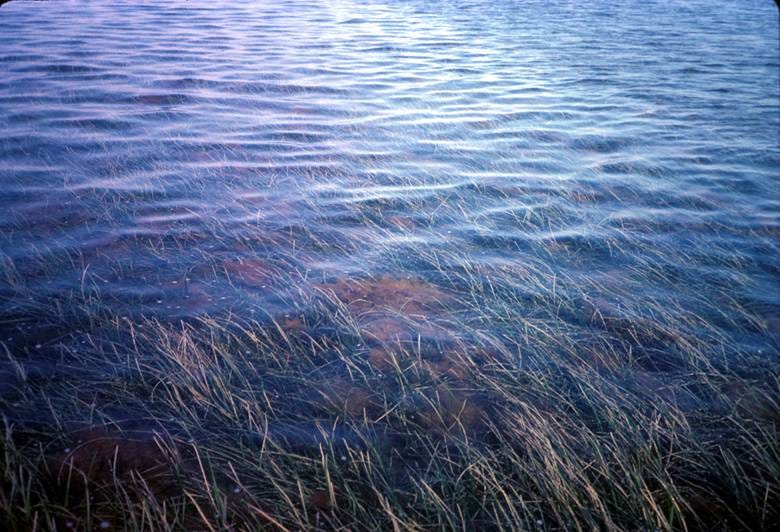
Eelgrass meadow
But timing is everything. According to researchers with the US Geological Survey who had been monitoring eelgrass in Pleasant Bay for several years prior to the new breach, eelgrass reproduces both by spreading rhizomes below the sediment surface and by setting seeds in the summer that sink to the bottom. The seeds need appropriate environmental conditions to germinate and grow. The April breach led to increased flushing, higher tides, clearer water – all conditions for improved water quality. Seeds germinated, grew and by the middle of the summer of 2007, the eelgrass population had expanded significantly. By the summer of 2009, the grass beds were extensive throughout the bay. But there were also some signs of deterioration. Seaweed was growing at the base of the grass and marine growth was visible on the blades. Very healthy eelgrass has neither.
How could scallops repopulate in the bay when there had been so few for so many years? That question remains a mystery – no one has successfully unlocked the secrets of the bay scallop life history, and they remain enigmatic little creatures.
Their more familiar cousins, Atlantic sea scallops (Placopecten magellanicus), often just called scallops on restaurant menus, live in deep water offshore and spawn multiple times.
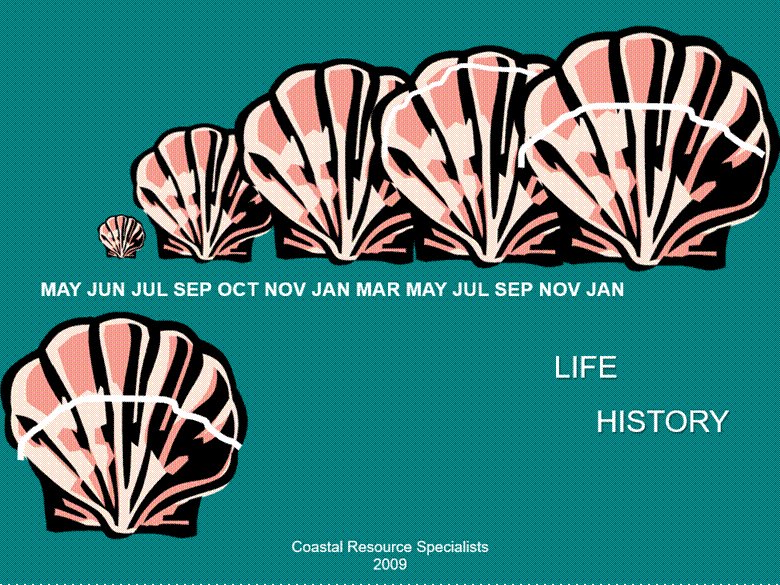
But bay scallops only live for two years. State law mandates that they have gone through their once-in-a lifetime spawning in order to be harvested. They are born in the summer, stop growing in the late fall and go “dormant.” When the water temperature rises in the spring, they begin to feed again and grow. As they grow throughout spring and summer, the new shell becomes obvious as a raised ridge that may be further defined by a color change. That shell change is the definition of a raised annual growth ring. They spawn that summer, live through the winter and die the following spring. This life cycle is the reason scallop season is a winter fishery and goes from October 1-April 30. Legal scallops MUST exhibit a raised annual growth ring that is clearly visible on the shell because it means they have gone through their one and only spawning season and will be dead by the spring.
Scallops are functional hermaphrodites – producing both millions of eggs and sperm in the same animal. While it’s improbable for a scallop to fertilize its own eggs in the wild, it may help the population if fewer individuals are needed to produce lots of seed. The yo-yo population dynamics of scallops, peaks and valleys over time, makes them more unreliable to depend on than any other commercial estuarine species. When lots of adults produce seed, there should be a continuous supply year after year but for some reason, it never works out that way. A short lifespan and extreme sensitivity contribute to population fluctuations.
Scallops appeared in the Nauset estuary’s Town Cove in 1985. Their appearance there was also curious. There had been no breach in the beach to alter the placement of the inlet or change in Nauset’s flushing characteristics, and the inlet was as far north as it had ever been historically, resulting in convoluted channels to the Cove.
But on Saturday of Columbus Day weekend, scallop season opened to a gorgeous picture-perfect day. Low tide was in the morning. By about 10:00, cars lined the road to the landing for about a half mile. This time, it was recreational permit holders who would benefit most since a large area was set aside for them where commercial fishing could not take place. Commercial boats were relegated to deeper areas.
The scallops were smaller than those in Pleasant Bay, but no one seemed to care. Scallops were worth about $15.00/lb. in the market at that time and a bushel yielded about six pounds. So, the $5.00 resident permit fee that allowed a person to get a bushel a week, was a bargain, well worth the effort to get the scallops and shuck them all to stock the freezer.
Hundreds of people walked around in the shallow water, picking up “nuggets of gold” with quahaug rakes or even everyday garden rakes. Clad in jackets or sweaters, hip boots, waders or just old sneakers, they searched for areas where others may not have already been. Some took a half bushel since a bushel can get pretty heavy. What I remember most were the smiles and laughter as they came back to the landing on their way home. Such an unexpected treat for them.
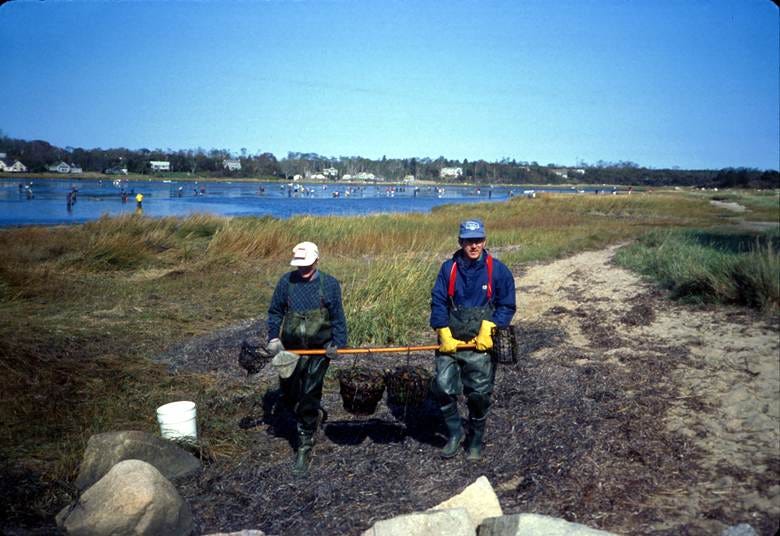
It happened again over a decade later and the appearance of scallops was even more of a mystery. Eelgrass had disappeared from the estuary and had not returned. What had they attached to as juveniles? Why were there so many after an absence of so long? What had happened to produce them? The answers are elusive and we just don’t know.
The appearance of scallops caused a stir of another kind. Some folks suggested that the improved water quality in Pleasant Bay after the breach in 2007 meant that Mother Nature had provided her own wastewater management plan and that the town basically “lucked out” and didn’t need the plan to address future needs.
However, in 1987, the colossal breach changed the dynamics of the bay in a very similar fashion. Eelgrass increased but scallops did not magically appear in any significant quantity. Moreover, within a decade, water quality had significantly deteriorated even though the inlet had not migrated very far south. It was a short-lived reprieve but certainly not a permanent fix.
After many years of discussions, the town embarked on an expansive and expensive wastewater management plan, currently being implemented.
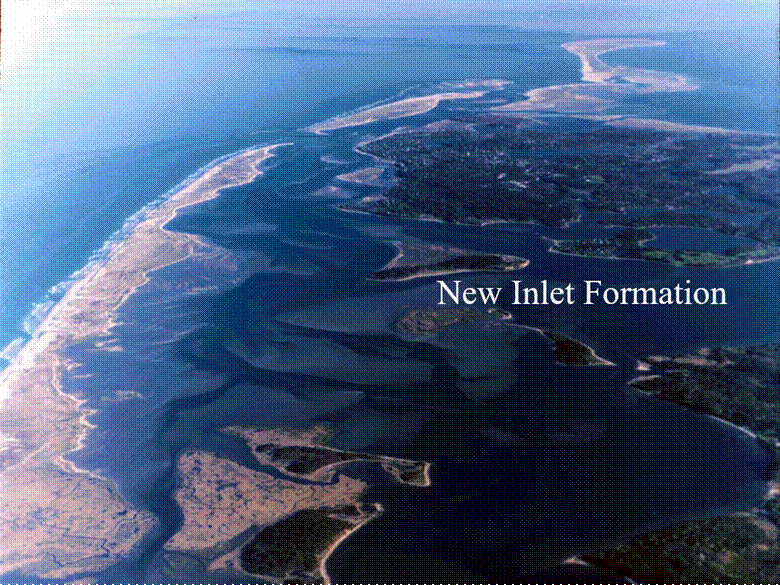
Historic Breach of 1987 Courtesy Kelsey/Kennard Photos
Martha’s Vineyard has always been a scallop-producing place. When production began to decline, as it did everywhere in SE Massachusetts, the Martha’s Vineyard Shellfish Group worked to change the script. They developed a regional public shellfish hatchery to raise seed shellfish to replenish the bays of the island and included bay scallops along with quahaugs and oysters. After several years, they were successful in raising scallops in the hatchery and they developed nursery systems to ensure their survival in the field. They have been able to smooth the yo-yo population fluctuations through their efforts and scalloping remains a viable fishery.
Nantucket was the last place to experience the decline in scallops. They took a cue from the Vineyard success and have been able to keep their fishery going as well with their scallop culture efforts.
But unfortunately, bay scallops are extraordinarily susceptible to environmental changes. And changes in the coastal zone have been numerous and have severely degraded water quality. We don’t know all the mechanisms, but we do know we have caused harm to the seas around us. Restoration methods work but they take a lot of resources – financial, and the public will to carry out restoration programs over many years.
While restoration efforts can succeed, natural scallop production seems to be only a memory. We wish it were not so. We wish their diminished population was just the inexplicable nature of bay scallops. We wish to see “scallop fever” grip communities again.
But if farming these beautiful, enigmatic animals is the future, as it is with many other shellfish species around the world, then maybe we can enjoy these succulent morsels once more for a regionally produced product. And I smile at that possibility.
Demand for native bay scallops remains very high, supplies are often very low, and when they are in our midst, they are truly nuggets of gold.
But this season is not one for new trucks.
Adapted from the books Rowing Forward, Looking Forward and Swirling Currents, by Sandy Macfarlane
Beautiful piece on the ecology of scallop population dynamics. The connection between the 2007 breach and improved eelgrass habitat is fascinating, especially since the mechanism still isn't fully understood. One overlooked angle here is how those byssal thread attachements to eelgrass create a sort of refuge network, the spatial patterning of eelgrass meadows probably matters as much as total coverage when it comes to survivorship thru that vulnerable juvenile stage.
As I’ve become accustomed to in your writing, the expertise is fabulous.
I might suggest that the narrator’s voice—”I” remain singular rather that occasionally switch to “we”. Keeping that stance, keeps the focus—at least for me.
Check out some of the common punctuation uses of commas, and a few references to antecedents. Nothing overwhelming, but perhaps jarring to former English teachers!!
The px are great, the whole is fine, and the blend of the personal with the scientific explication and descriptions is always a pleasure..