Herring - Part 2

In mid-May, many herring runs are alive with fish traveling in both directions, those heading up the river or stream to spawn and those that have made it to the spawning grounds, performed their ritual, and are returning to the sea.
But in some locations, fish are stymied. Their instinct thwarted. Passage to their spawning grounds blocked. They are victims of our continual alteration of the landscape. We let the stream water flow, but it may be slowed by undersized and poorly maintained culverts or gushing over dams, impossible to leap over.
And so, the millions of herring that once made the streams look like “rivers of silver,” have dwindled to a tiny fraction of what they once were.
Herring have always been an important fish. Because they feed on plankton, they are near the bottom of the food chain, close to the ultimate energy source, the sun. They provide food for everything above them, fish, land animals, birds. Their abundance was an ecological gift to balance the connection between land and sea. They have been important to humans including generations of indigenous people who relied on them and taught early colonists about their many uses and how to fish for them.
There are two types of herring: Atlantic (or sea-run) herring are strictly marine and river herring (blueback and alewives) are anadromous (spawn in fresh water and spend years in the ocean). There are multiple obstacles to survival of both types, but river herring are particularly vulnerable and their numbers have plummeted from former abundance. The reasons for the decline and challenges of recovery for them can be broken down into two main categories. Barriers on land and bycatch (unintended harvest) at sea.
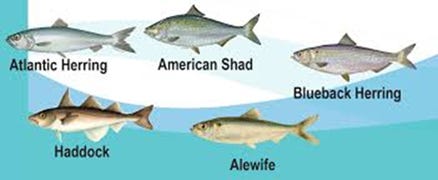
NOAA Fisheries
Land – Where it Begins
As the population grew after colonization, the people created land obstructions. We began to disrupt the flow of rivers and eventually upset the delicate balance. Roads crossed streams and wagons drove through them. Crossings were improved by filling in the banks of the rivers and installing a pipe through the filled stream bed. The water flowed but was more restricted. Debris naturally accumulated that reduced the flow even further to the point that the fish could no longer get to their spawning grounds.
Mills were constructed next to rivers using the water to power the machinery of the mill. As the industrial revolution progressed, more rivers were dammed to provide hydropower. New England became an economic center because of its many mills lining the major rivers in town after town. Dams may have been much smaller than the giant dams elsewhere in the U.S., but without fish ladders, they were an impassible barrier for fish migration.
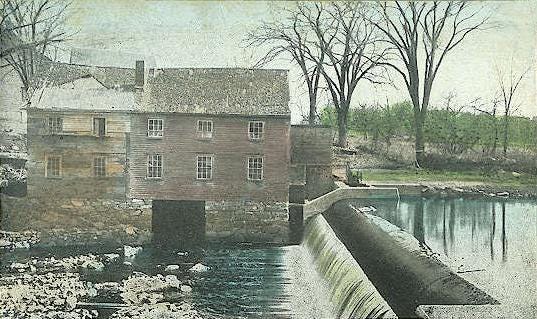
Wikimedia Commons
Few people considered the larger picture in relation to population dynamics. Each blocked stream is a loss of habitat and the potential loss of millions of fish that come to produce a new generation. Harvesting too many fish means fewer fish to create that new generation.
In both cases, the cumulative effect can be devastating.
Now, we are beginning to realize those effects and are taking action to restore both habitat and the populations.
A Daunting Task
Correcting past alterations is a daunting task. The challenge is immense and the fish population, especially in southern New England, remains in a precarious position.
And yet, there is hope for the future. The land side of the equation is undergoing change, in attitude and infrastructure. The restored ladder at Damariscotta Mills, discussed in the previous article on herring, is an example of the passionate affinity for the annual fish migration and the community resolve to support the project, stick to it, and get it done. And the residents take pride in their accomplishment, continuing the financial obligation to maintain it. They are not alone. Restoration projects throughout the region have taken place, are under construction or are in the planning stages.
For perspective, the Connecticut River empties into Long Island Sound. It is the longest river in New England at over 400 miles. The Connecticut River Conservancy is a good example of cooperative efforts throughout a five-state region. The Conservancy notes that there are thousands of dams in the watershed, many of which are obsolete and tens of thousands of stream crossings, (bridges and culverts), many undersized. They and their partners have restored over 427 miles of river habitat through dam removal and upgraded culverts. That is just one river.
On the other end of the spectrum are smaller projects like the Coonamessett River restoration in Falmouth, MA. This was a run that produced millions of herring at the turn of the 20th century. In 2015, there were fewer than 75,000. The restoration was a phased project to remove dams, replace failed culverts, purchase riparian land, and create wetlands. Native plant seeds, buried under cranberry bogs, and dormant for generations, were viable and repopulated the wetlands with native vegetation when the natural hydrology was reestablished.
After 16 years, (2009-2025) the town achieved full restoration. The landscape changed from cultivated cranberry bogs to free-flowing habitat, unobstructed passage for the herring and eels, nearly 80 acres of wetland with a meandering stream, and access to a 158-acre spawning pond. The wetlands absorb carbon and nitrogen, and the public gained nature trails and increased resilience as climate continues to change.
David Weeden, Mashpee Wampanoag Tribal councilman was quoted on CAI, the local NPR station. He was at the celebration held at the completion of the project and said that it represented more than fish passage. “It’s about reconnecting with the lifeways that sustained our people long before colonial boundaries were drawn,” he said. “Reestablishing cold-water habitats is ecologically healing, and it’s also an example of a cultural shift that recognizes the rights of nature.”
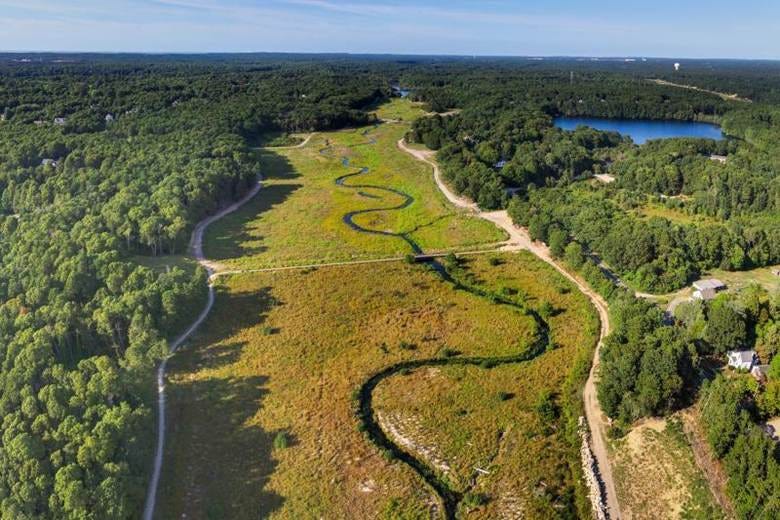
NOAA Aerial view of the restored lower Coonamessett River. Credit: Adam Soule.
In Maine, the Penobscot River restoration project is an example of a huge, multi-year, multi- goal project. A primary portion was the removal of two major dams and a bypass of another while many smaller dams were also removed. The project was initiated as an attempt to enhance the last remaining native Atlantic salmon populations and salmon have begun to return. But herring benefited as well. Over 2000 miles of habitat were reopened for fish passage and millions of herring returned to the river above the site of one of the major dams where none were seen before the removal.
Herring Counters
In the late 1960s, foreign factory ships fished the tremendously productive waters of the western North Atlantic. They harvested and processed staggering amounts of fish. All the species of commercially important fish seemed inexhaustible. But they weren’t. River herring were as vulnerable as all the other commercial species being fished. Even when harvesting switched to the domestic fleet, the population continued to decline. Concerned managers looked to protecting the spawning areas.
By 2005, the state placed a moratorium on harvest of herring from any runs in MA. The Division of Marine Fisheries needed baseline data for stock assessments and they needed help. They reached out to the communities for assistance. And the people answered the call.
Today, organizations such as the Association to Preserve Cape Cod and the North and South Rivers Watershed Association coordinate many of those efforts. Massachusetts also has a statewide monitoring network, and annual counting workshops help train volunteers and standardize methods. Massachusetts is not alone. Organizations in other New England states mobilized to help count the fish too. In a good year, the counts can be demanding and highly focused work, because the fish may move quickly and in large numbers.
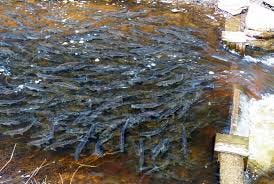
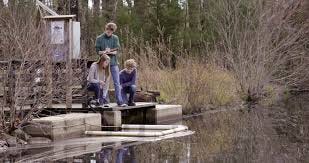
NSRWA; Photos by Alex Mansfield
Top: Fish counted as they go over the board. Bottom: Students involved in counting
When the harvest moratorium was imposed in 2005, it was anything but a difficult task. There were usually few fish to count at some runs, and many times, none. But the volunteers took their turn at their appointed times.
Observers explain their reasons for volunteering, even with low expectations. For some, it is the tranquility of the run itself. For others, it is a lifetime of observation and the chance to witness a natural event that has shaped coastal communities for generations. For still others, it is the hope of one day going there and finding fish swimming up the run.
In time, their hope was rewarded as the fish slowly came back.
The Ocean – Complications Multiply
The larger picture is more complicated. When river herring leave fresh water, they spend several years in the ocean, where they mix with Atlantic herring and other fish in large schools. That creates a difficult management problem: once fish are caught in a net, it is impractical to separate them species by species with confidence.
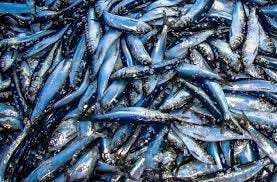
Atlantic Herring, NOAA Fisheries
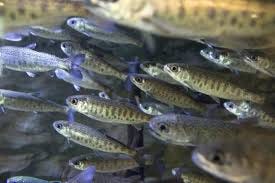
River Herring NOAA Fisheries; Calvin Alexander
That is why the focus has shifted toward avoiding risky schools before the tow. NOAA says river herring management includes efforts to reduce commercial fishing impacts, and that real-time information can help vessels avoid areas where interactions are more likely. In practice, that means fishery managers and captains are trying to make better decisions before fish ever reach the deck.
Acoustic tools can help with that effort. Multi-beam sonar can show the size, shape, and density of a school ahead of the boat, which may help indicate whether a tow is worth the risk. But sonar does not provide a perfect species count, so it is best understood as a risk-reduction tool rather than a precise identification system.
Laboratory analysis can help too. It is where otoliths becomes important. Otoliths, the small ear bones in a fish’s head, can preserve a chemical record that scientists use to infer where a fish originated. That kind of analysis is valuable for proving natal origin after the fact, but it does not solve the immediate problem of bycatch (non-target fish) at sea.
The good news is that both sides of the issue are moving in the right direction. On land, dam removal, culvert replacement, and habitat restoration are reopening spawning habitat. At sea, managers and fishers are working on ways to reduce bycatch before it happens. For river herring, recovery will depend on both.
I am almost 80. I try to learn about something new every day. Otolith chemistry for today.