Foot By Foot
A Steep but Enjoyable Learning Curve

As spring heads toward summer, my thoughs turn to changes in the bays where life reaches its peak. And memory goes back to the early days of my tenure with the Orleans Shellfish Department on Cape Cod, MA. Curiosity and observation were key to learning about marine life and interactions in the estuaries. What I was trying to accomplish was new to everyone in the department, including me.
What follows are my recollections of those early days, recounted in my book, Rowing Forward, Looking Back. It is a bit longer than my usual posts but I hope it is of interst.
I had this great job. Now what was I going to do with it?
Aside from the shellfish that were my primary responsibility, I also had to know about other aspects of the estuaries - who used them and for what purpose? Which activities would ultimately affect shellfish and how?
Orleans has three separate estuaries within its jurisdiction. Each estuary was completely different from the others. Cape Cod Bay, is the large expanse of water encompassing the shoreline of the flexed arm that is the shoreline from Marshfield to Provincetown. Orleans’ portion is a sliver of shoreline that is about a mile wide but sand flats extend for a mile offshore.
Nauset/Town Cove, is an exquisite mixture of coastal environments that remain incredibly productive despite being adjacent to a major highway and a busy-downtown commercial area.
Pleasant Bay, is the largest estuary of its kind on the Cape and a true gem any way you look at it. It is within the jurisdiction of Orleans, Chatham, Harwich and a tiny bit of Brewster.
These three diverse systems were my laboratory. What made them distinct from one another? Why were some plants or animals found in one and not another? How could they be so different and yet be so close as the gull flies? Why did certain species of shellfish do well in one place and not another? Would I ever be able to answer those questions?
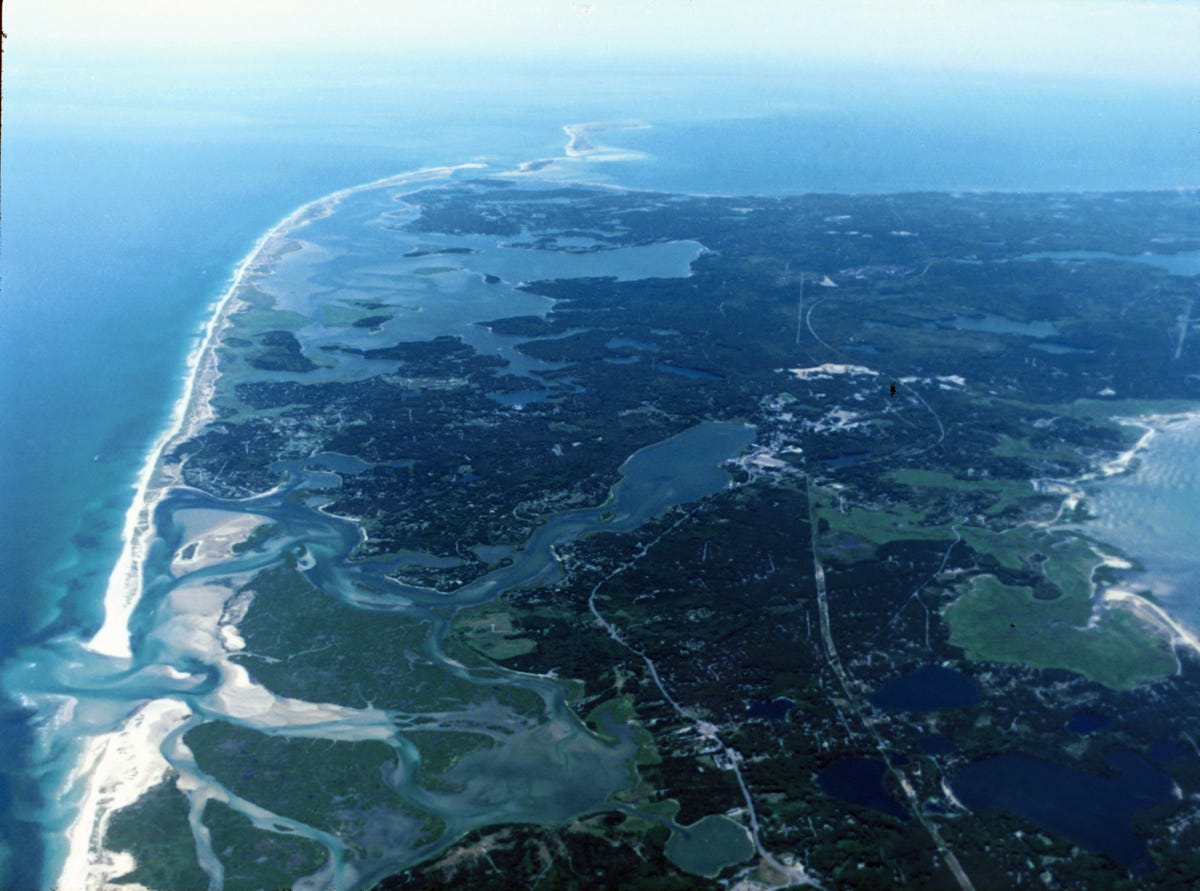
Orleans estuaries looking South: Pleasant Bay (top); Cape Cod Bay far right; Nauset/Town Cove (bottom). Photo by Kelsey/Kennard
Numerous researchers have described Cape Cod as a geographic and biologic dividing line. It is the northern limit of southern species most commonly found near the Gulf Stream, one of the world’s longest and most influential currents, and the southern limit of northern species found inhabiting the colder boreal waters along the Labrador Current. Orleans epitomizes that dividing-line with its three separate estuaries exhibiting different natural regimes. Northern species could be found in Cape Cod Bay and sometimes Nauset, for example, while some southern species were found in Pleasant Bay but rarely Nauset and never Cape Cod Bay.
The first thing I needed to do was to get acquainted in a more up front and personal manner with the shoreline and estuaries. I devised a check list of plants and animals common to the region, added sediment types to the list, got a pair of hip boots, bought a basket scratcher and lined it with quarter-inch galvanized hardware cloth, and set out walking, looking, and recording my observations. I parked at a town landing and walked all around and then back again. Or I asked waterfront property owners if I could park in their yard. Not only was I never refused, most of the time I was the recipient of some neighborly gesture. The people were terrific.
As I walked along, I was struck by the diversity of the shoreline. Sand, gravel, cobble, silt, shell, mud and all combinations. Coarse and fine sand, gravel with rocks - every conceivable combination of sediment types, often changing abruptly from one to another in a matter of a few feet. Animals were present in some areas and absent in others, those patterns also changing abruptly.
Then there were the creeks that led to salt marshes. These were shoreline indentations, once coves, that had gradually filled in with sediment. They had developed over thousands of years into some of the most productive ecosystems in the world. Some of the marshes were no bigger than an acre or two and others were vast systems covering tens of acres. The bigger the marsh, the bigger the creeks feeding it. The sediment at the bottom of a creek was usually soft, a function of the slow water velocity constantly depositing fine materials, except at the mouth where the fine materials were washed out of the creek. Often there was a sand delta at the mouth, beyond which was often a bottom of softer sediments. Salt marshes are where red-wing blackbirds flit and marsh hawks hover overhead and a fox searches for small animals for her pups. The marsh creeks may be filled with mummichogs and stickle-backs, small fish darting through the water as the tide comes and goes. And yes, the marsh is also home to the interminably pesky greenhead fly whose worldly “value” we may not know but whose bite we surely do know.
Birds foraged as the tide went out, searching for those morsels that would tide them over. There were large boulders, dropped in place by the glaciers, with barnacles or mussels or various types of seaweed attached, depending on what body of water I was at.
As I walked along the shores of both Nauset and Pleasant Bay, rivulets of fresh water flowed from the land. In the summer, old sneakers replaced the clunky hip boots and I could feel the marked difference between cold fresh water and the warmer salt water. Some of those streams were also marked by red sand and in that red sand, there were rarely clams and almost never quahaugs. But slightly offshore, where fresh and salt water intermingled, was a different story. Quahaugs were often found there. Wherever there were fresh water rivulets, there were usually large colonies of mud snails, seemingly gliding along the bottom.
Scratching around large boulders usually revealed a little group of quahaugs. Clams lined the shores in places and in other places there were hardly any. Sometimes there were no shellfish for a long distance alongshore and I’d try to figure out what was so different. Sometimes I saw shell fragments but no live specimens and other times I’d find species of shellfish that were not commercially important. Once in a while I’d find a real oddity, something that the guide books said was rare for the region.
There were clams on sand bars close to the ocean and as far from the ocean as the upper reaches of the estuaries. There were mussels in Nauset but none in the Orleans portion of Pleasant Bay. Quahaugs were almost everywhere in Nauset. But they were few and far between in Pleasant Bay. There were worms that looked like beige ribbons and worms that looked like red thread.
Even better than walking the shores, however, was use of the town workboat whenever I wanted. I used a “look box” with a clear Plexiglas bottom that I could use to peer into the water from the boat.
I observed the watery world by travelling slowly in shallow water, either with the engine idling or by letting the boat drift in the tide. Using the boat that way didn’t do much for the engine but it was incredibly revealing to me. I compared areas when the tide was low and the critters were hiding and when it was high and they were all moving about. In the summer, I also snorkeled in Pleasant Bay. I was fascinated to see tiny seed scallops attached to eelgrass before they were large enough to fend for themselves on the bottom.
As the boat drifted over the immense eelgrass meadows that existed in the bay then, I often saw pipefish, which resemble sea-horses, or various species of other small fish darting through what must have been a forest to them. I saw tiny snails attached to the blades of grass and tinier, circular, white hard-shelled worms seemingly glued on to the grass for decoration. There’d be patches of sand with no grass and then thick grass again. Why?
I drifted over the shores that I had walked at low tide, watching the multitude of animals move around in their element. I watched the struggle for survival among species. I’d dig something up and watch and time how long it took the animal to dig back into the sediment. I dug up small conchs, predatory animals that can drill a perfectly round hole in the shell of a clam or quahaug, and wonder how it found its prey. I watched a moon snail wrap its “foot” around a clam and then cover it with a gelatinous substance so that the clam couldn’t siphon water. Seeing all this wasn’t much like work to me.
There were starfish in Nauset, none in Pleasant Bay, and blue crabs in Pleasant Bay and none in Nauset. Tiny gem clams that looked like baby quahaugs were extremely common in Pleasant Bay and almost non-existent in Nauset. The amount of life I saw was endless - I always saw something new. I bought an array of guide books to help me identify what I was seeing.
In lousy weather, I often traveled to Woods Hole to the Marine Biological Laboratory library, one of the foremost libraries of its type in the country. There, because I worked for the town, I was able to obtain journal articles on all aspects of marine science. I was beginning to plug in those variables that make marine ecology special.
I learned to identify the marine life, but to me, that was only a small part of the picture. I needed to know the whole picture. What interacted with what? Where did we fit into the scheme? What areas were heavily used and what ones were less popular and why? Actually, “why” became my favorite word. I needed to look critically at each separate body of water throughout the year to get a sense about how each fit into the bigger picture.
Later in this learning process, when I was in my 14’ Cape Dory in Pleasant Bay, I sometimes stopped rowing in the middle of Little Bay and just turned my boat in a circle and looked around. Out there, thinking about the tremendous number of plants and animals that gain sustenance from this bay, I felt small in comparison to the grandeur around me. I recognized that although humans are the largest user, in all senses of the word, we are only one of many, not the only one involved in the “budget” of the Bay.
The biodiversity of Pleasant Bay is immense. The Massachusetts Division of Marine Fisheries found over 60 species of fish and shellfish alone in one survey conducted in1967 and they did not sample for crustaceans or other invertebrates besides shellfish. In 2002, the state’s Natural Heritage and Endangered Species Program listed 7 species that were Endangered, Threatened or of Special Concern. Not only does the Bay have much of the same species diversity found in the Nauset system, but because it also has undeveloped islands, the bay has the added biomes of upland and transitional areas between land and sea.
In 2017, the Center for Coastal Studies conducted a study for the Friends of Pleasant Bay to compare the Bay to the 1967 DMF report. But they were also tasked to provide a full ecological analysis that would be a second baseline. This comprehensive study points out the importance of generally unseen species that contribute greatly to the overall diversity of the bay.
Pleasant Bay helped me gain a true understanding of the complexity of estuaries and the surrounding upland. I don’t mean I understand everything about them. Quite the contrary. I mean that I view them as interrelated systems and I hope I will always be learning more about them. I see the whole but I also see the parts, each part a discrete habitat with transitions from one part to another.
Traveling from the inland areas surrounding Pleasant Bay to the ocean, the habitats include upland, coastal banks, marshes, beaches, tidal flats, cobble, submerged lands and overlying waters, and islands with beaches, marshes, thickets and some upland. Lastly one finds more tidal flats and then the dunes of the outer beach with the Atlantic Ocean beyond. In the upper parts of the bay there are the semi-enclosed quiescent ponds, some of which lead even further inland to fresh water ponds. The flowing water between the fresh water lakes and ponds and the salt ponds is the pathway for the herring (an extremely important food source for larger fish) to swim annually from the sea to the lakes in the ancient ritual of procreation.
These separate habitats and the transition zones between them contain a complexity of interdependent life that is truly amazing, from large mammals to tiny beach fleas and all manner of life in between.
The intertidal and nearshore area is home not just to clams and quahaugs, but also home to crabs and worms and other forms of life that provide food for the thousands of shorebirds that stop to rest and feed on their yearly migrations north and south. The water is teeming with plankton, the young-of-the-year that will become the fish and shellfish and predators of the following year. The islands provide refuge to some animals where predators may not be as numerous as on the mainland. Ospreys have made a comeback, thanks in part to the platforms erected by humans for their nests. The fish that find themselves gripped in the osprey’s talons may not be grateful to us, but ospreys were part of the landscape before humans nearly killed them off with DDT. Now they are back.
The horseshoe crab, related to spiders and a member of earth’s community for hundreds of millions of years, plows its way across Pleasant Bay’s shallow waters in search of its favorite food, the gem clam. The one-eighth-inch gem clam is a mollusk that looks like a miniature quahaug, except that the purple is on the outside of the shell. There are probably billions of them in the bay.
This is merely a sampling of the number of terrestrial, intertidal, aquatic, and avian species that utilize the bay’s complexity during a normal year.
When you look at Orleans as a whole, the three separate and highly productive estuaries make the town’s coastal resources extraordinary. They provide habitat for four of the major species of commercially important shellfish: soft-shell clams, quahaugs, bay scallops and blue mussels. They provide habitat for spawning, nursery or feeding of dozens of fish and other invertebrate species and habitat for the huge populations of migratory and non-migratory birds. Species diversity and complexity of habitats is what makes the area so special, but I also learned that its exquisite complexity is what makes it so fragile.
I got to know the waters quite well. I knew them intimately, foot by foot. Some stretches of shoreline I felt compelled to walk again and again, often not really knowing why they struck me so. Others I walked once and lost interest and didn't go back to for a long time. I realized quickly that investigating the shoreline just once in a while was not enough. The shoreline may look the same but it is constantly changing and the animals that make their home there might be there one year but not the next, possibly pushed out by something else that was more efficient for living in just that space at that particular time. The shore subtly evolved as much as I did.
It didn't take me long to realize that plugging in the variables for this ecology exercise was not going to be a piece of cake. I was at the bottom of a steep learning curve.
Your best so far. Keep it up.